Posts about Android
All the posts...US Mobile
28 September 2026

A couple months ago, my AT&T Wireless bill breached $90 per month for a single device, so it was time to do something about it. I looked around and US Mobile looked interesting: I could prepay $199 for a year of adequate service, and I could choose which of the 3 major networks. The ability to switch networks on the same plan was even more intriguing.
I already knew AT&T was mostly fine, but a bit weak in my house, so I gave T-Mobile’s network a try via my US Mobile account to start out. I found the T-Mobile network was really fast, but maybe the slighly weak signal was killing my phone’s battery faster than I had expected. The phone was always a little warm. It was time to "teleport" my line to the next network in my test. Verizon seemed a bit stronger, and it’s mostly fine for battery life. I could again see battery estimates over 24 hours, instead of 12 hours. (I realize now when you read about people seeing terrible battery life on the "new Pixel" or whatever, it may be fine for you, since it may be the network conditions causing battery drain.)
US Mobile calls each network a different name: Warp (Verizon), Lightspeed (T-Mobile), and Dark Star (AT&T). I had eliminated any monthly payments for an entire year for just $199. Many phones allow you to have 2 active eSIMs, and US Mobile had an introductory deal to have a second (and 3rd) eSIM on the other networks simultaneously for $45 per line. I splurged and activated 2 more eSIMs for the other networks, so I could use all 3 networks in my travels for an entire year. I can have 2 active at a time, so I have Warp and Lightspeed always on. If I see my primary network looks a little weak, I switch my data service over to the other SIM. If neither of the 2 look great, I activate the 3rd SIM to replace the backup SIM and run Warp and Dark Star at the same time. Theoretically, the phone will automatically switch to the second SIM, but service needs to be completely gone on the first, and that doesn’t often happen.
I like to run speed tests across all the networks when I have a chance. I most recently ran the test at the top of a mountain in the Michaux Forest. Dark Star was the winner there giving me 1200Mbps downloads! I was excited to test all 3 networks to find any glimmer of service at my favorite campground on another weekend.
At this point, I’ve spent $290 for a year of service on all 3 networks to use as I see fit. I think the second year will be $270 + $90 + $90, so maybe I’ll know enough to choose 1 or 2 network, but even if I keep all 3, I’ll still be saving over half over my old post-paid AT&T account.
SmartThings Home & Away
27 November 2023
I have Samsung SmartThings automatically setting the thermostat and turning things on and off for me based on the location of my phone (and me).
Of course, it stopped working, so I needed to debug. All the other things connected to the hub were working fine.
Things That Didn’t Fix It
-
Restart my phone
-
Wipe the SmartThings app data on my phone and login again
-
Restart the SmartThings Hub
-
Check app permissions on the phone: no optimization, fine location access always on.
The Fix
-
Open SmartThings app on the phone
-
Menu
-
Settings Cog
-
Get your location from this phone
-
Turn it off, then back on
-
Visit my 2 location-based triggers and re-add myself as a member.
-
Fixed!
Digital Archeology
04 February 2023
Nostalgia for Old Code
I’ve been coding for a very long time, so I’ve had lots of projects in various languages, on various platforms, and stored very differently.
I got nostalgic on and off over the past couple years and went digging around to recover the source for some of those old projects. I uploaded the more notable projects to my GitHub account.
Old Floppies
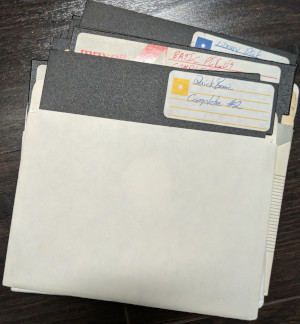
I spent money to buy a 3.5-inch USB floppy drive and an old 386 PC with a 5.25-inch and 3.5-inch floppy drive, so I could ultimately copy files from really old 5.25-inch floppies that I used in the late 1980s and early 1990s to my live storage of today. Among those old files were binaries and source in GWBASIC and QuickBasic.
QuickBasic
I found one of the first games I wrote and sort of distributed, Gravity Blocks. I could play the compiled binary with DOSBox and read the main source file, but some of the source code for my common libraries is still locked up in a compressed format from QuickBasic 4.5. I may need to dig deeper into QB64, a clone of QuickBasic 4.5 that seems to be able to read, run, and compile those old compressed files.
GWBASIC
I also found source code for the first software I wrote for the local fire company to help track statistics on calls and print reports to submit to the local municipalities we served.
It was written in GWBASIC, so I was able to decode the compressed source where needed to read it. I published my CALL-REP source, so I could go back and have a look at the simple, but useful, things I used to write as a kid.
Copies of Old Servers and Subversion
I continued to build stuff through college (and obviously beyond). Some of it was in C, PERL, and Java.
I recovered these bits
of source code
laying around in backups and copies
of old Linux servers I’ve run
over the years.
This source was in old Subversion repositories
that used old versions of Berkeley DB.
Initially,
This BDB version mismatch
kept svn checkout from working,
but the current Subversion tools
have an svnadmin recover command
that could fix the repository
for normal reading today.
I’m sure some
of those old SVN repositories
had previously been migrated
from CVS.
Java
I found the source code from my final project in the Java class in my last year of college in 2000.
Pop-a-Prof is a clone of my favorite puzzle game, Bust-a-Move. It’s a Java Applet that ran in Netscape allowing any number of players, and it coordinated everyone’s play with a shared public server, Each round lasted 5 minutes, and any time you topped-out, you’d lose some points, and start over, so no one needed to sit around watching the last people battle it out.
After school, I started on Pop-a-Prof 2. This one ran as a plain Java application, and implemented rebounding balls in the game. It was more of a proof-of-concept for the new game mechanics, and it never got network play.
Java ME
I liked running little bits of code, like applets did, so I continued into writing Java ME (J2ME) for my feature phones around 2005.
I did a gas-logging app that stored fuel-ups and drew graphs to show fuel economy.
I also wrote a quick little game called Ben’s Backhoe to give the kids a little something to do on my phone. By the time I was building this sort of thing, though, I’m a decent Java programmer, so it’s not the fun mess that we see in the other old project.
Still More
I spent most the day poking around at various old BASIC files and trying to tweak them a bit to run in PCBasic or QB64. I used lots of weird graphics modes from the Tandy 1000 and didn’t think much about portability. I may post more projects over time.
Podcast List for November 2022
03 November 2022
I have 73 feeds I currently follow. I have a whole system of prioritization, so I can listen to important things first. I’ve listed them alphabetically here:
-
99% Invisible https://feeds.simplecast.com/BqbsxVfO
-
All About Android (Audio) https://feeds.twit.tv/aaa.xml
-
All Songs Considered https://feeds.npr.org/510019/podcast.xml?uid=n1qe4e85742c986fdb81d2d38ffa0d5d53
-
Android Central Podcast https://androidcentral.libsyn.com/rss
-
Arrested DevOps https://www.arresteddevops.com/episode/index.xml
-
At Liberty https://feeds.soundcloud.com/users/soundcloud:users:40330678/sounds.rss
-
Back to Work https://feeds.fireside.fm/backtowork/rss
-
The Best of Car Talk https://feeds.npr.org/510208/podcast.xml
-
The Candid Frame: Conversations on Photography https://thecandidframe.libsyn.com/rss
-
CaSE: Conversations about Software Engineering https://www.case-podcast.org/feed/aac
-
The Changelog: Software Development, Open Source https://changelog.com/podcast/feed
-
ClojureStream Podcast https://feeds.soundcloud.com/users/soundcloud:users:627190089/sounds.rss
-
Cognicast https://feeds.feedburner.com/cognicast
-
The Daily https://feeds.simplecast.com/54nAGcIl
-
Darknet Diaries https://feeds.megaphone.fm/darknetdiaries
-
defn https://feeds.soundcloud.com/users/soundcloud:users:220484243/sounds.rss
-
Distractible https://feeds.megaphone.fm/QCD8163454930
-
Do By Friday https://feeds.simplecast.com/5nKJV82u
-
Do By Friday After Show (Private Link)
-
Don’t Ask Tig https://feeds.publicradio.org/public_feeds/dont-ask-tig/itunes/rss.rss
-
Engineering Culture by InfoQ https://feeds.soundcloud.com/users/soundcloud:users:258266127/sounds.rss
-
Escape Pod https://escapepod.org/feed/podcast/
-
Everything is Alive http://feeds.everythingisalive.com/everythingisalive
-
FLOSS Weekly (Audio) https://feeds.twit.tv/floss.xml
-
The Fox News Rundown https://feeds.megaphone.fm/FOXM1880458659
-
Freakonomics Radio https://feeds.simplecast.com/Y8lFbOT4
-
Functional Geekery https://www.functionalgeekery.com/feed/mp3/
-
Global News Podcast https://podcasts.files.bbci.co.uk/p02nq0gn.rss
-
Grammar Girl Quick and Dirty Tips for Better Writing https://feeds.simplecast.com/XcH2p3Ah
-
Groovy Podcast http://groovypodcast.podbean.com/feed/
-
Hacker Public Radio http://hackerpublicradio.org/hpr_rss.php
-
Hanselminutes with Scott Hanselman https://feeds.simplecast.com/gvtxUiIf
-
Hidden Brain https://feeds.simplecast.com/kwWc0lhf
-
How I Built This with Guy Raz https://rss.art19.com/how-i-built-this
-
Interview Podcast – Echoes https://echoes.org/category/program-highlights/interviews/feed/
-
Jeffery Saddoris: Everything https://pcr.apple.com/id1438550795/
-
JS Party: JavaScript, CSS, Web Development https://changelog.com/jsparty/feed
-
JUXT Cast https://feeds.feedburner.com/JuxtCast
-
LensWork - Photography and the Creative Process https://www.lenswork.com/podcast.xml
-
Linux Inlaws https://linuxinlaws.eu/inlaws_rss.xml
-
Lost in Lambduhhs https://anchor.fm/s/581d4eb4/podcast/rss
-
Marketplace All-in-One https://www.marketplace.org/feed/podcast/marketplace-all-in-one
-
The Mortified Podcast https://feeds.feedburner.com/MortifiedPod
-
No Stupid Questions https://feeds.simplecast.com/dfh_verV
-
NPR News Now https://feeds.npr.org/500005/podcast.xml
-
Oh No, Ross and Carrie https://feeds.simplecast.com/ftB6Gihc
-
On the Media https://feeds.feedburner.com/onthemedia
-
People I (Mostly) Admire https://feeds.simplecast.com/rP60Wf24
-
Podcast – Cory Doctorow’s craphound.com https://feeds.feedburner.com/doctorow_podcast
-
The REPL https://feeds.therepl.net/therepl
-
Security Now (Audio) https://feeds.twit.tv/sn.xml
-
Smashing Podcast https://feeds.transistor.fm/smashing
-
Software Defined Talk https://www.softwaredefinedtalk.com/rss
-
Software Engineering Radio - the podcast for professional software developers https://seradio.libsyn.com/rss
-
Song Exploder https://feed.songexploder.net/SongExploder
-
The Stack Overflow Podcast https://feeds.simplecast.com/XA_851k3
-
TED Radio Hour https://feeds.npr.org/510298/podcast.xml
-
This American Life https://www.thisamericanlife.org/podcast/rss.xml
-
This Week in Tech (Audio) https://feeds.twit.tv/twit.xml
-
Thoughtworks Technology Podcast https://thoughtworks.libsyn.com/rss
-
Wait Wait… Don’t Tell Me! https://feeds.npr.org/344098539/podcast.xml
-
Welcome to Night Vale http://feeds.nightvalepresents.com/welcometonightvalepodcast
-
What’s Your Problem? https://www.omnycontent.com/d/playlist/e73c998e-6e60-432f-8610-ae210140c5b1/32c25e85-1667-4acb-99fd-ae3c0021f33e/beacef48-19d2-4f52-b9e8-ae3c0021f347/podcast.rss
-
Wicked Good Development https://anchor.fm/s/81a22db8/podcast/rss
-
Wrong About Everything https://wrongabouteverything.libsyn.com/rss
-
WTF with Marc Maron Podcast https://feeds.acast.com/public/shows/62a222737c02140013aa4c03
-
You Are Not So Smart https://feeds.simplecast.com/N5eKDxJI
All the Posts
September 2026
- 28 - US Mobile
November 2023
February 2023
- 04 - Digital Archeology
November 2022
August 2022
- 24 - Podcast Addict
January 2022
October 2020
August 2020
- 30 - Listening to Music
April 2020
- 08 - Past Phones
March 2020
- 03 - Pixel 3 XL